actuators · industrial robots · robotics engineering · automation
Actuator Technology in Large-Scale Autonomous Systems: Hydraulic vs Electric Power
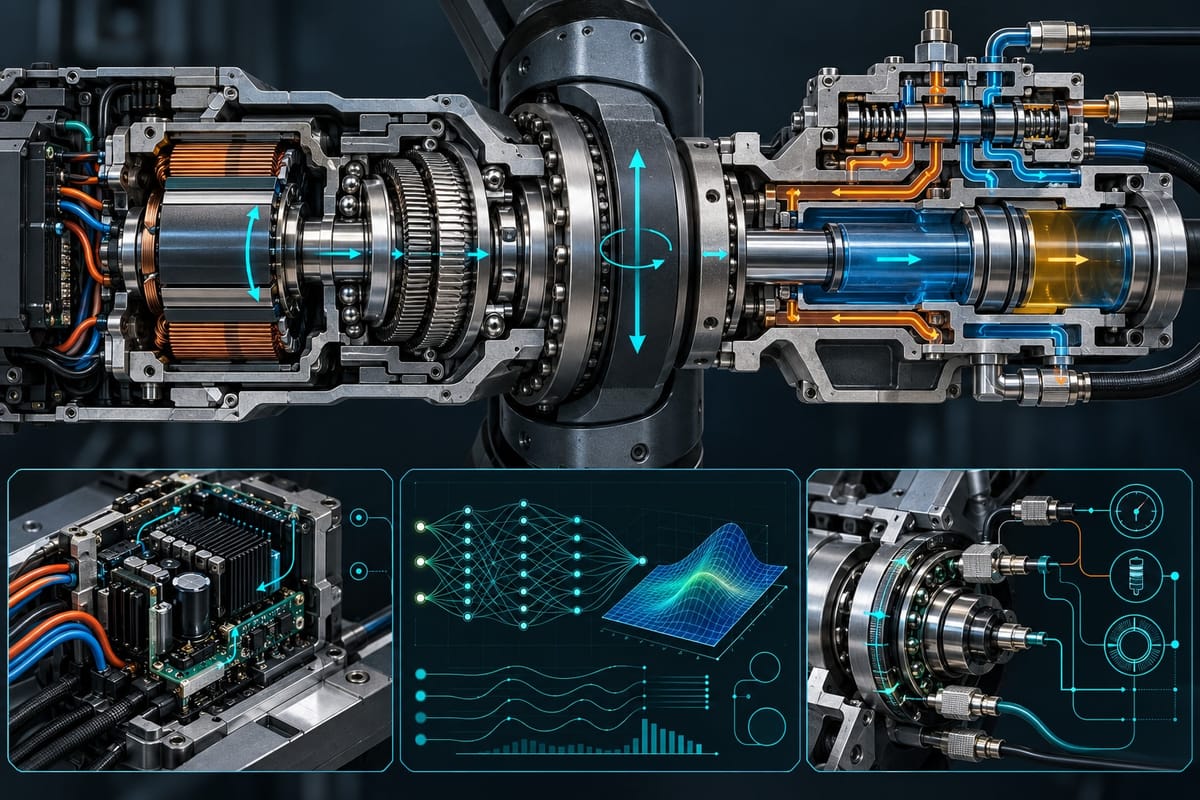
When a 100 kg warehouse robot lifts a pallet or a quadruped construction robot steps onto uneven terrain, the actuators driving those joints face brutal mechanical demands: high torque, precise position control, thermal stability, and the ability to absorb shocks without failing. The choice between hydraulic and electric actuators shapes the robot's performance envelope, maintenance schedule, and total cost of ownership.
Power density and torque delivery
Hydraulic actuators deliver exceptional power-to-weight ratios. A compact hydraulic cylinder can generate tens of kilonewtons of force, making it the dominant choice in legged robots that need explosive leg extension or high-load manipulation. Hydraulic systems achieve torque densities above 50 Nm/kg at the actuator level, which remains unmatched by most electric motors without expensive rare-earth magnets and precision gearboxes.
Electric actuators—typically brushless DC motors paired with harmonic or planetary gearboxes—offer lower raw torque density but vastly simpler integration. Modern frameless motors with integrated controllers reach 20–30 Nm/kg, and recent quasi-direct-drive designs reduce gearing ratios to improve backdrivability. For wheeled robots moving across flat warehouse floors, electric drivetrains provide more than enough torque while avoiding the complexity of hydraulic plumbing.
Precision, control bandwidth, and compliance
Electric actuators excel in position control. Encoders mounted directly on the motor shaft deliver sub-degree resolution, and modern motor controllers close position loops at kilohertz rates. This precision is critical for warehouse pick-and-place systems that must align grippers within millimeters. Electric systems also handle velocity profiling cleanly: trapezoidal and S-curve ramps are trivial to implement in firmware.
Hydraulic actuators introduce compliance and damping naturally. Fluid compressibility and valve dynamics soften impact forces, which helps legged robots tolerate ground strikes and uneven surfaces. However, hydraulic control loops lag behind electric systems. Servo valves add latency, and pressure ripple from pumps injects noise into the feedback signal. Tuning a hydraulic position controller to match the bandwidth of a modern electric servo requires expensive proportional valves and sophisticated compensation.
Thermal management and duty cycles
Electric motors generate heat in the stator windings, and that heat must escape through the motor housing. Continuous high-torque operation quickly saturates thermal capacity, forcing derating or active cooling. Warehouse robots that run eight-hour shifts often use oversized motors or liquid cooling jackets to maintain performance. Gearboxes add another thermal bottleneck: inefficiency in gear mesh turns input power into heat, and sealed harmonic drives have limited convection paths.
Hydraulic systems centralize heat generation in the pump and reservoir, where it can be managed with large oil coolers and fans. The actuators themselves remain relatively cool because they perform mechanical work without resistive losses. This thermal separation allows hydraulic robots to sustain peak torque for extended periods, a key advantage in construction environments where a quadruped might hold a static pose under load for minutes.
System architecture and integration complexity
Electric actuators plug into a robot with three wires (power) and one data cable (CAN, EtherCAT, or RS-485). The entire drivetrain fits inside the joint envelope, and there are no fluid leaks, no pumps, and no accumulators. For mobile robots, this compactness translates to simpler mechanical design and faster prototyping. Scaling an electric robot from four to six wheels or adding an extra manipulator joint requires minimal replumbing.
Hydraulic systems demand a central power unit, high-pressure hoses, fittings, and a distribution manifold. Every actuator adds another pair of fluid lines, and routing those lines through articulated joints without kinking or chafing requires careful mechanical design. Hydraulic robots also carry the weight of the pump, reservoir, and filtration system. The payoff is raw power: a 200 kg legged robot with hydraulic legs can carry its own weight in payload, whereas an equivalent electric design would struggle without adding significant motor mass.
Maintenance, reliability, and field serviceability
Electric actuators require minimal scheduled maintenance. Bearings eventually wear, and gearboxes need periodic lubrication, but modern sealed units can run for thousands of hours between services. Failures are typically electrical: burned windings, failed encoders, or controller faults. Diagnostics are straightforward because motor controllers log fault codes, temperatures, and current spikes.
Hydraulic systems need regular fluid changes, filter replacements, and seal inspections. Contamination from wear particles or water ingress degrades performance, and a single blown seal can leak enough oil to shut down a robot mid-shift. Field repairs often require specialized tools and training. However, hydraulic components are modular: a failed cylinder or valve can be swapped in minutes if the hoses use quick-disconnect fittings.
- Electric actuators favor environments with clean floors, predictable loads, and access to charging infrastructure.
- Hydraulic actuators suit outdoor construction sites, high-payload applications, and scenarios where impact absorption is critical.
- Hybrid systems—electric mobility with hydraulic work functions—appear in some specialized platforms.
Cost and supply chain considerations
Electric drivetrains benefit from economies of scale in the automotive and drone industries. Brushless motors, motor controllers, and harmonic drives are commodity components with multiple suppliers. A complete electric actuator module (motor, gearbox, controller, encoder) can cost $500–$2,000 depending on torque and precision requirements.
Hydraulic systems require more upfront investment. A complete hydraulic power unit with pump, reservoir, valves, and filtration starts around $3,000 for small robots and scales quickly for higher flow rates. Actuators themselves (cylinders or hydraulic motors) are relatively inexpensive, but the total system cost remains high. The trade-off is durability: hydraulic systems in construction equipment routinely log tens of thousands of hours.
Emerging trends and hybrid designs
Recent developments blur the hydraulic-electric divide. Electrohydrostatic actuators (EHAs) pair a small electric motor with a local hydraulic pump and cylinder, eliminating central hydraulic power units while retaining high force density. These units appear in aerospace and are beginning to migrate into robotics. On the electric side, quasi-direct-drive motors with low gear ratios improve backdrivability and force sensing, narrowing the compliance gap with hydraulics.
Some warehouse robots now use electric drivetrains for mobility and small hydraulic or pneumatic actuators for end-effectors like suction grippers or clamping jaws. This hybrid approach isolates the complexity of fluid power to the task-specific tooling while keeping the main chassis simple. For more on how robots process sensor data to coordinate these actuators in real time, see Edge inference: running vision models on robot hardware.
Choosing the right actuator for the application
Warehouse automation favors electric actuators. Predictable loads, smooth floors, and the need for precise positioning align perfectly with the strengths of brushless motors. Maintenance teams prefer the cleanliness and simplicity of all-electric systems, and warehouse operators value the quick scalability when adding new robots to the fleet.
Construction and outdoor logistics push toward hydraulics. Uneven terrain, high payloads, and impact tolerance demand the power density and compliance that only hydraulic systems deliver at scale. The maintenance burden is accepted as part of the operating model, and field technicians are already familiar with hydraulic service from traditional construction equipment.
As robotic platforms grow more capable, the actuator choice remains a fundamental design constraint. Engineers balance torque, precision, thermal capacity, integration complexity, and lifecycle cost to match the actuator to the mission. Understanding these trade-offs is essential for anyone working on the next generation of industrial autonomous systems. To see how government policy shapes the deployment of these robots at scale, explore US federal robotics funding vs China's industrial policy.